 Global Politics
Nov 21 - Chapter 2.1 – Contested meanings of rights and justice
Chapter 2.1 – Contested meanings of rights and justice
big book: p. 94-114
book 2: 177-206
Fundamentally, rights and justice are closely linked to power - the focus of global politics, how people function and interact in society is directly impacted by how power is distributed and challenged
Key Concepts of Rights and Justice:
- Power
- The ability to affect change, an aspect of relations among people in social organization
- Sovereignty
- a state's right to make decisions independently.
- How states choose to apply and enforce rights and citizens is important to study
- Legitimacy
- a state / actor having authority to exercise power over others
- in rights and justice, legitimacy is called into question
- Interdependence
- mutual reliance among groups, organizations, geographical regions, etc.
- can be economic or based on values
- THEMATIC CONCEPTS OF RIGHTS AND JUSTICE
- Equality
- all people have the same intrinsic value. One of the most important concepts to consider
- Liberty
- Divided into negative and positive liberty
- negative liberty
- freedom from coercion, they shouldn't be forced to do something they don't want to do
- positive liberty
- people being able to do what they want to do.
- one of the most essential concepts
- Justice
- being treated fairly and getting what they deserve
- Rights
- rights are essential to living a life of dignity and purpose
Universal Declaration of Human Rights (UDHR)
After the end of the second world war, representatives from France, Soviet Union, the United States, and UK discussed what life should look like after the end of the war – members of the allied forces. Ultimately became United Nations
Members of UN security council: China, France, UK, US, USSR
Purpose of UN in article 1:
- maintain international peace & security
- develop friendly relations among nations based on respect for the principle of equal rights and self-determination of peoples
- to cooperate in solving international economic, social, cultural, and humanitarian problems. Promoting human rights and freedoms
- center for harmonizing actions of nations to attain these ends
UDHR was adopted by UN general assembly on 10 December 1948, celebrated as Human Rights day
Lists 30 different rights
| Civil rights and liberties |
|
| Legal rights | |
| Social rights | |
| Economic rights | |
| Political rights | |
| Cultural and solidarity rights |
Universal Declaration of Human Rights | United Nations
non-binding agreements: agreements that contain political or moral agreements, but not legally enforceable, therefore if broken state doesn't face legal consequences, but legitimacy may be questioned.
The declaration is non-binding.
Page 102 - key principles of UDHR
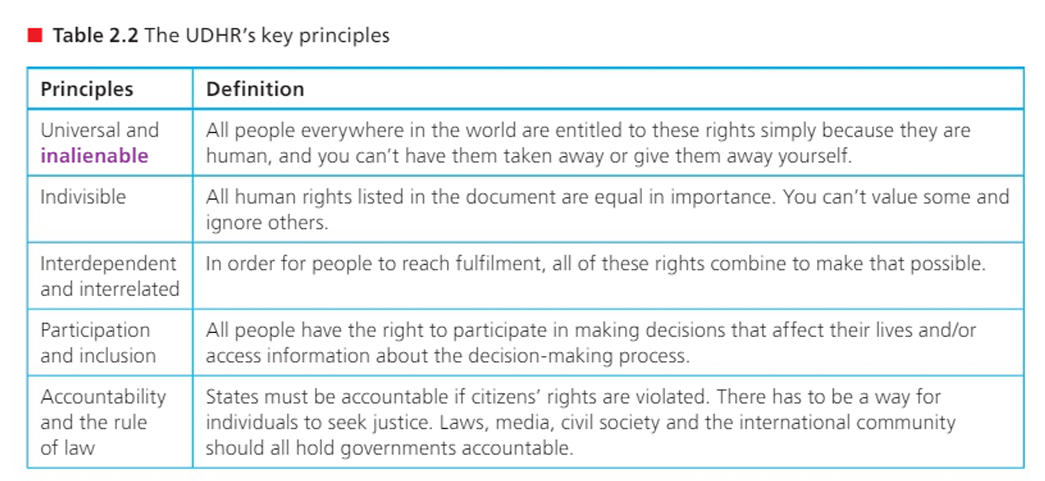
based on idea that human rights are natural and not dependent on laws, culture, or beliefs
Positive and Negative Rights: p 103
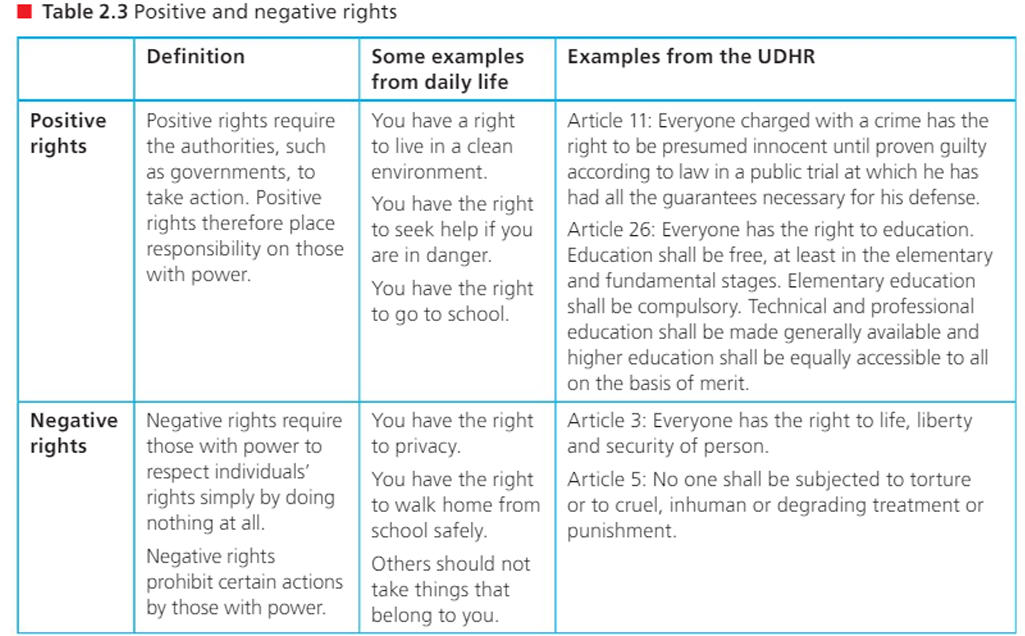
Positive Rights: require actor to take action - place responsibility on those with power
Negative rights: require those with individuals to respect individuals by doing nothing - prohibit certain actions by those with power
This distinction may be blurred - prison guards should not abuse, but also step in to prevent abuse
often in real life these are interdependent
3 generations of human rights
human rights sometimes divided into 3 categories, called generations
French revolution demanded: liberty, equality, fraternity
Fraternity: being a part of a community, looking out for each other
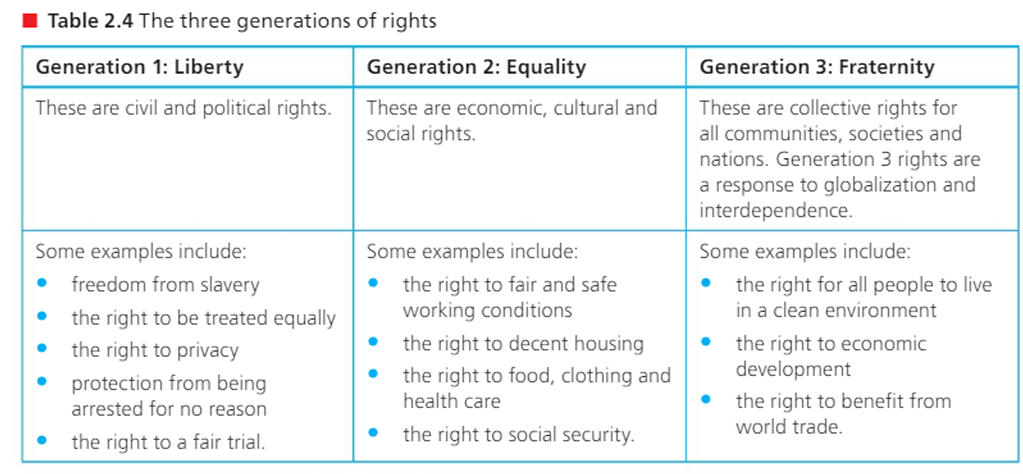
1st generation similar to negative rights, while 2nd similar to positive rights. 3rd unique, focused on rights of community rather than individual
Collective rights:
These are the rights of groups of people or communities. Usually considered when looking at those sharing cultural or ethnic identity – example could be ‘right to self-determination’
if people live in state where potentially mistreated, may demand creation of own state to preserve culture. Example: Palestinian community and Catalonian people in Spain have demanded self-determination.
Self determination is these people having right to decide own type of government and form a new state (if it is what the group wants)
Some rights like freedom of religion can be seen from both individual and group perspective
Cultural Relativism:
we mostly look at western fields of thought, Cultural Relativists say all cultures have unique characteristics and moral codes, so morals should be decided by community on local scale, not universally like the UN. Say that the UDHR is western values imposed on global community
Article 3 states people have right to life – challenges death penalty (aka capital punishment), the horrors of early 20th century challenged idea that states could abuse capital punishment.
Universalism (human rights belong to all people regardless of culture, religion, nationality, etc.) and this are 2 perspectives when looking at real-world politics of rights and justice
Theoretical views on rights and justice p. 106
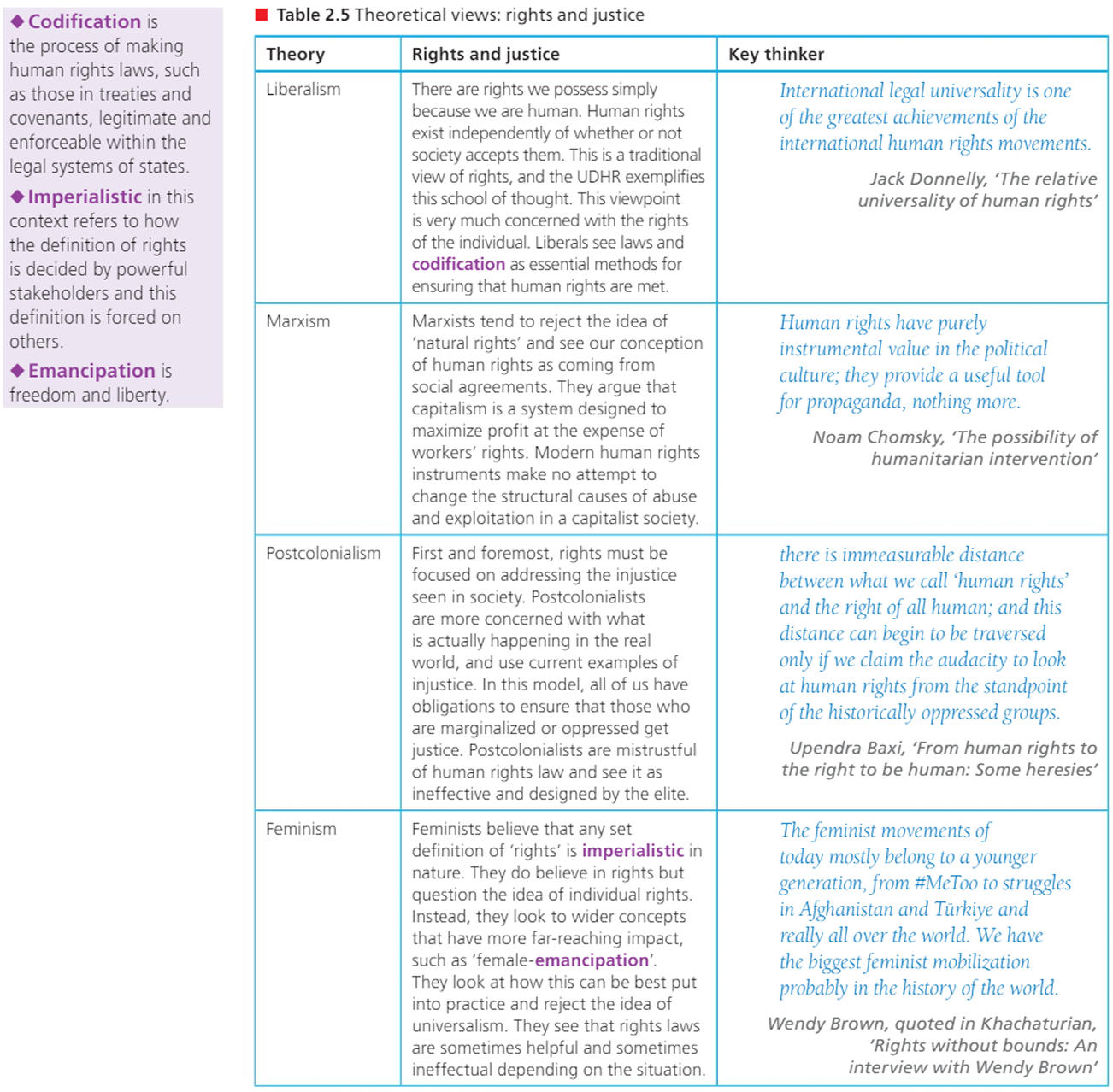
Realists largely view rights and justice as irrelevant in GP – because argue states make decisions on national interest and ethics play no role in the decisions
Definitions, interpretations of and perspectives of justice
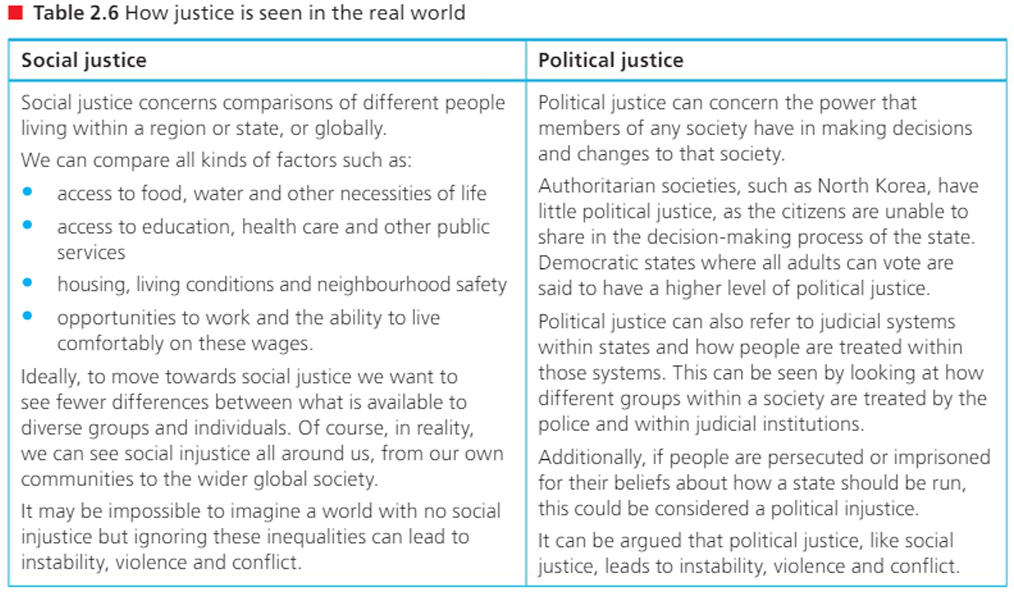
from social justice:
- comparing of people living in a region
- ignoring inequalities can lead to instability, violence and conflict
political justice:
- power members of society have in making decisions and changes in society
- also refer to how people are treated in judicial systems (police, judicial institutions)
- political justice can lead to instability, violence and conflict
social and political injustice is interdependent
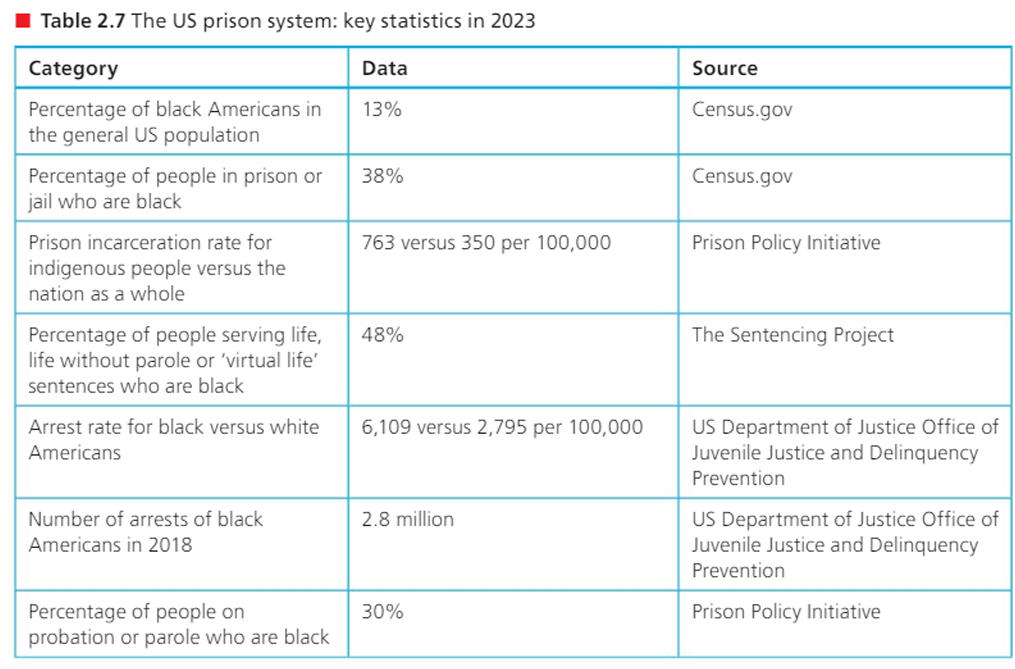
Case study (?) - disproportionate Black people in US prison system
TOK: social media has ‘bubbles’, where algorithms pay attention to how long attention has been held on, and provides content we are likely to watch. Only embeds our own beliefs, and prevents us from having to think critically about views.
Egalitarian justice:
Egalitarian justice focused on social justice. Key principles:
- all individuals in society must be treated with equal respect and dignity
- all people should have equal freedoms and opportunities
- We are moral beings with innate understanding of right and wrong
- We inhabit a world where people pay attention to economics and politics, but moral identity cannot be overlooked
Cosmopolitan justice:
takes egalitarian view further, argues all people must work at achieving justice for all individuals on a global scale. IGOs have obligation to act when needed. Sometimes soverignty is seen as an oibstacle to justice, and intervening is justifiable if:
- state is structurally ‘unjust’, if there is a totalitarian regime abusing citizens, or state is not addressing needs of citizens
- the intervention will succeed – difficult since required prediction and assurance that it will result in justice
- all other methods have been attempted without success, intervention is the last resort
This view says we are morally obligated to help migrants and refugees. borders are important for state sovereignty, states may find migrants as a threat to sovereignty and social stability – may accept them or not grant legal status. Many migrants face uncertainty and structural violence
According to the United Nations Refugee Agency:
- 70 per cent of refugees and other people in need of international protection live in countries neighbouring their country of origin.
- 76 per cent of the world’s refugees and other people in need of international protection are hosted by low- and middle-income countries. The least economically developed countries provide asylum to 20 per cent of that number.
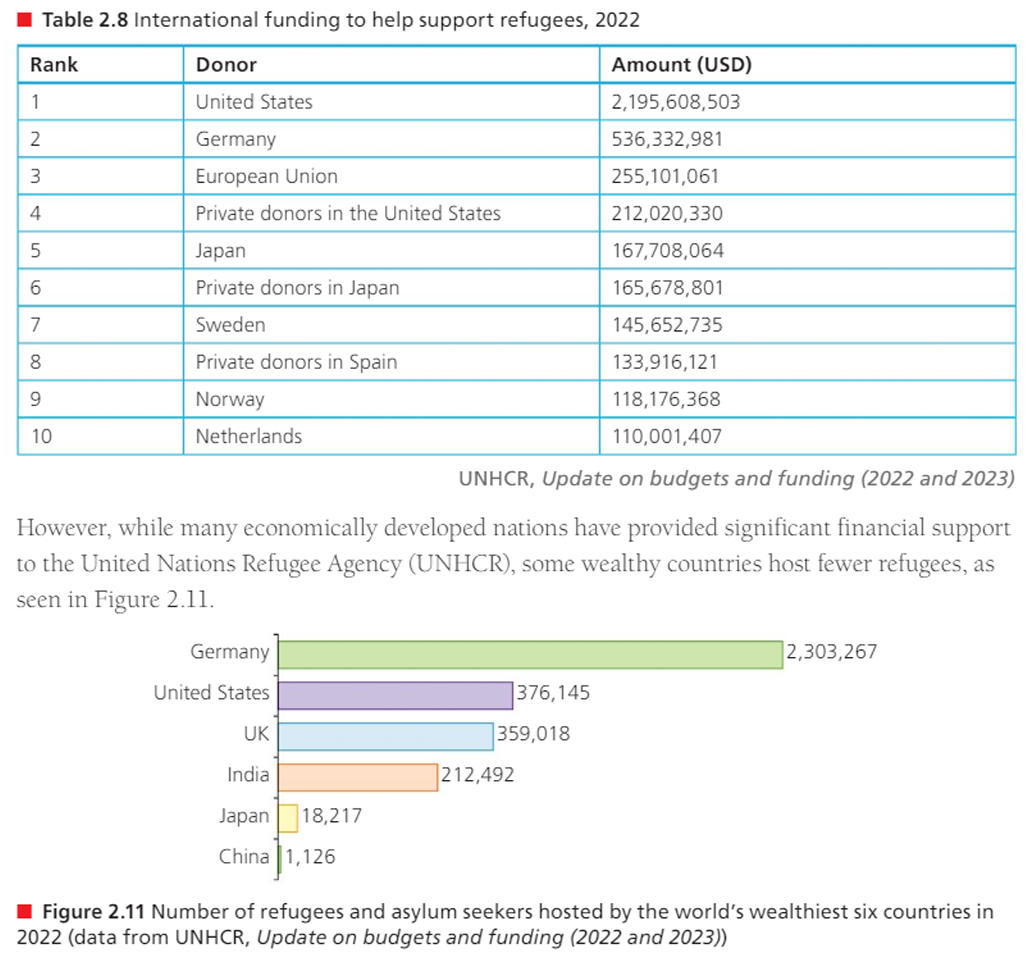
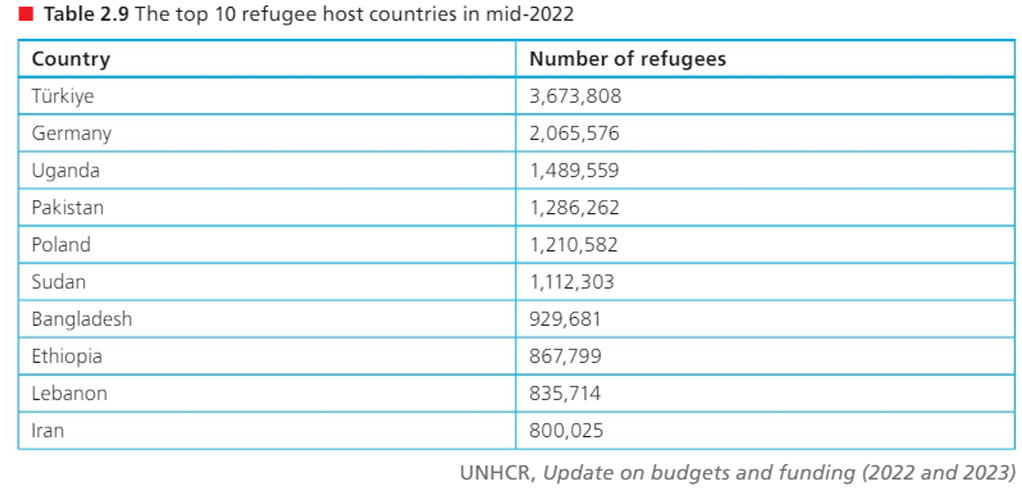
often see that economically developed states provide financial aid but are less likely to host refugees
Ecological Justice:
usually humans are the focus. Ecological justice advocates for considering all living beings. Our future cohabitation depends on being more conscious and proactive for other living beings
Zulu Ubuntu:
In South Africa, Zulu people refer to the concept of Ubuntu. The idea that community is the essential building block of society.
“my humanity is inextricably bound up in yours, we belong in a bundle of life”
It is an important philosophy by environmentalists focused on communal approach to rights and justice.
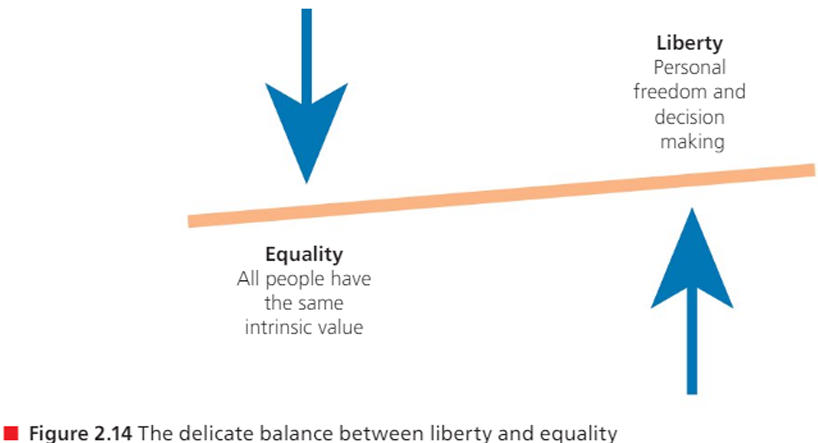
We have seen how ‘liberty’' is about personal freedom and the ability to make choices / decisions for yourself.
while ‘Equality’ is the idea that all human beings have equal worth and value.
These concepts will also be considered in rights and justice
Extended Essay:
can make about local or regional interpretations of justice, look into indigenous people’s concepts of justice could be an interesting start. a good extended essay must consider multiple perspectives
Review Questions:
- According to John Rawls, ‘A society regulated by a public sense of justice is inherently stable.” Using this quotation and what you have learned in this chapter, write your own definition of ‘justice’.
- What evidence of the importance of liberty and equality can you see in the Universal Declaration of Human Rights?
- When we talk about ‘contested meanings’ we're not saying that these different meanings are always in complete opposition to each other. It is important to see that there can be agreement, particularly when looking at real-world examples. For example, in what ways might a cultural relativist view agree with a postcolonialist view of rights and justice? Can you think of a real-world example to support your claim?