 Global Politics
Readings
Why are Human Beings Violent
Why are Human Beings Violent.pdf - Google Drive
Believes it is part of childhood conditioning, that both visible and invisible (like ignoring the acceptance of feelings and emotions) acts of violence will shape them into a certain way
“The tragic reality of human life is that few
people value the awesome power of the individual
Self with an integrated mind (that is, a mind in
which memory, thoughts, feelings, sensing, con-
science and other functions work together in an
integrated way) because this individual will be
decisive in choosing life-enhancing behavioral options (including those at variance with laws and norms)” - Page 2
“If you want a child who is nonviolent, truthful, compassionate, considerate, patient, thoughtful, respectful, generous, loving of itself and others, trustworthy, honest, dignified, determined, courageous and powerful, then the child must be treated with – and experience – nonviolence, truth, compassion, consideration, patience, thoughtfulness, respect, generosity, love, trust, honesty, dignity, determination, courageous and power” - Page 2
Some see it as caused by social structures
What is Peace
What is Peace.pdf - Google Drive
Peace is "naked, poor,
and mangled," wrote Shakespeare. To be called a
pacifist is almost an insult, to be labeled cowardly
or selfish, unwilling to fight for what is right. It is
easy to arouse people to war, said Hermann Goering at the Nuremberg trials. “All you have to do is tell them they are being attacked and denounce the pacifists for lack of patriotism…”
"Peace is more than the absence of war. It is also
"the maintenance of an orderly and just society,"
wrote Howard-orderly in being protected against
the violence or extortion of aggressors, and just
in being defended against exploitation and abuse
by the more powerful.7 Many writers distin-
guish between negative peace, which is simply
the absence of war, and positive peace, which is
the presence of justice."
“Gandhi's meaning was deftly sum-
marized by Jonathan Schell: "Violence is a method
by which the ruthless few can subdue the pas-
sive many. Nonviolence is a means by which the
active many can overcome the ruthless few." Yet
the word nonviolence is "highly imperfect," wrote
Schell. It is a word of "negative construction," as if
the most important thing that can be said about
nonviolence is that it is not something else. It is a
negation of the negative force of violence, a double
negative which in mathematics would yield a posi-
tive result. Yet English has no positive word for
it. Schell attempted to resolve this dilemma by
defining nonviolence as "cooperative power"-
collective action based on mutual consent, in
contrast to coercive power, which compels action
through the threat or use of force.11
Peace does not mean the absence of conflict,
argued peace researcher and former Australian
ambassador John W. Burton. Conflict is intrinsic
in human relationships, although it does not have
to be and usually is not violent. The challenge for
peace practitioners is to find ways in which com-
munities can resolve differences without physical
violence. In this context peace is understood as a
dynamic process not an absolute end point. The
goal of peacemakers is to develop more effective
ways of resolving disputes without violent con-
flict, to identify and transform the conditions that
cause war.”
can simply mean absence of violent conflict, yet not including changing social structures.
Just War - Page 37 of Theories of Global Politics
Jus ad bellum – right to go to war
Jus in bello – right conduct in war
difficulty: For example, if we consider the criterion of right intention under jus ad bellum then who gets to decide whether or not the intention is right or not?
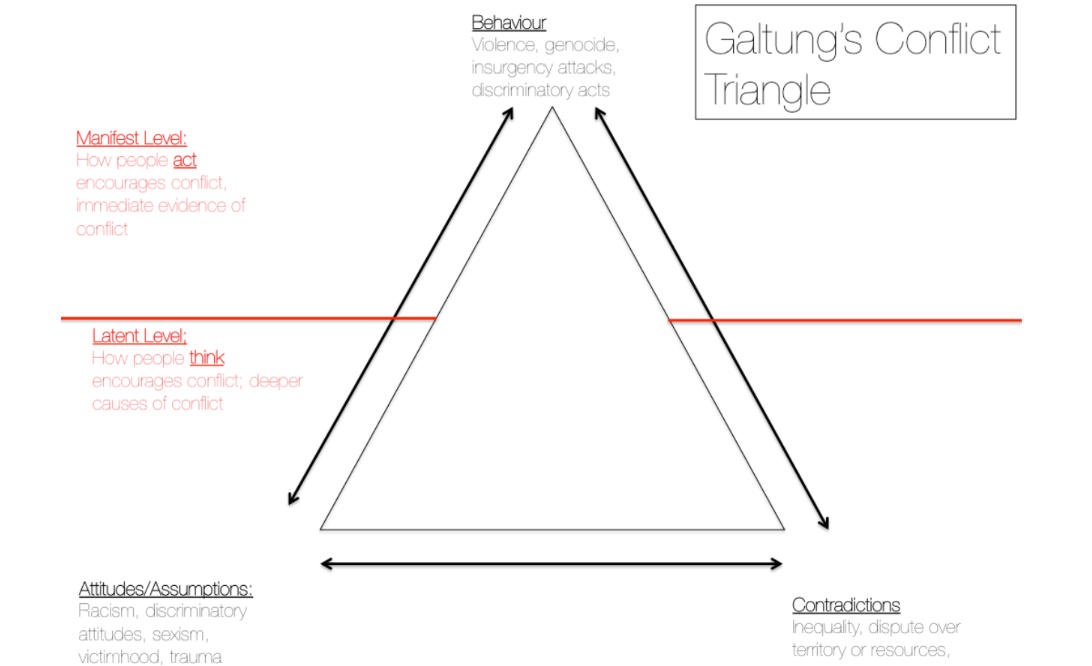
Galtung's Conflict triangle - 41
Galtung defines violence as 'any physical, emotional, verbal,
institutional, structural or spiritual behaviour, attitude, policy or condition that diminishes,
dominates or destroys others and ourselves'.
Using this definition we can see that violence can be regarded as one of several possible
responses to conflict but is not necessarily unavoidable.
Galtung argues that in societies with conflict it is possible to identify both specific causes as well
as more general conditions that increase the likelihood of violent conflict.
He also argues both (or more) parties to conflict are likely to agree on the causes of the conflict.
Conditions making violent conflict more likely
Little or no democratic means of dispute
resolution; minorities excluded from
political representation
Wealth, territory or resources shared
unequally and controlled by powerful
elites
•Poverty
•Government is above the law, making
arbitrary and illegitimate decisions
•Judicial system is absent or interfered
with, not independent or fair
•Human rights are abused
Conditions making violent conflict less likely
Democratic institutions exist, with full
political equality and participation
Equal sharing of resources and wealth
Equality of opportunity for all
Government respects the rule of law
Disputes can be resolved fairly through a
fair and independent judicial system
Respect for human rights (especially of
minorities)