 Global Politics
Companion Reading
Feb 18
p.125-166
Introduction#
On one hand, development has led to decreased poverty, improvement to average life globally, and accumulation of wealth for states MNCs and some individuals. Though it has also led to growing inequalities both within and among states, human rights abuses, and global crises due to climate change.
This has caused sustainability to become inseparable to discussions of development
The 17 UN SDGs show that sustainable development requires global effort and cooperation – They also show sustainable development intersects peace, equality, environmental protection, and respect for human rights
Contested Meanings#
Can manifest in malnutrition, hunger, homelessness, social exclusion, and limited access to healthcare, sanitation and education.
A trend has shown its decline, which can be attributed by Newly industrialized coutnries (NICs), such as China and India are the biggest, together making a third of the world's population. – other examples: Malaysia, Brazil, Mexico, Turkey
“China managed to lift 800 million people out of extreme poverty between 1978 and
2000, and India has lifted over 90 million Indians out of extreme poverty between
2011 and 2015, according to World Bank figures.”
in 2018 Oxfam found the 26 richest people held as much wealth as the poorest half of the world's population
Extreme poverty is the lack of access to basic needs like water, shelter, and food. This is a measureable and solvable phenomenon – " ‘fixed’ by improving access to basic needs such as water, sanitation, food, shelter,
electricity, employment and, more recently, schooling and healthcare."
The international poverty line is currently $2.15 USD, though it may be misleading since it ignores other dimensions like undignified working conditions or vulnerability to disease.
Relative poverty aims to measure inequality by having a relative threshold. Can be defined as when a household makes less than 50% of the average household income. China has used relative poverty to measure income disparities between urban and rural areas.
This cannot be eradicated by economic growth alone, it requires social security and distributional measures.
Social Security is protection from gov. and society to ensure income security and access to healthcare (especially in case of unemployment, disability, age, maternity, etc.)
Distributional measures are actions by gov. to distribute monetary and social benefits in an equitable way. Perhaps by directing taxes to social services
This focuses on feelings of deprivation, social exclusion and inequality. Can see insight of race, ethnicity, geography, gender within society
Can be overly income /consumption based and may not capture other dimensions
Multidimensional Poverty is when there are multiple & simultaneous deprivations of basic needs.
in 2010 the UNDP (United Nations Development Program) and OPHI ( Oxford Poverty and Human Development Initiative) developed the Multidimensional Poverty Index (MPI), to not only capture who is poor but how they are poor. Analyzing health (Nutrition, Child mortality rate), education (Years of Schooling, attendance), and living standards (Cooking fuel, sanitation, drinking water, electricity, housing, assets).
There can be challenges to the idea that High Income Countries (HICS) have better well-being than medium and low income countries (MICs and LICs). A report from the Organization for Economic Co-operation and Development (OECD), found that certain middle-income, or less economically developed, countries have higher levels of subjective well-being than some high-income states.
Case study: Poverty in the DRC – p129
Although materially rich, brutal effects of colonization – with 62% (60mil) living in extreme poverty. Neighboring states like Uganda and Rwanda continue to exploit the resources and smuggle them
Development Generally means making the conditions of life better – improving economy, infrastructure, healthcare and education, political structures / institutions, and even environmental protections
Development was seen as a solution to poverty, especially in LICs
A progressive society is one that aims to better the human condition through developments in technology, industry, science and economic development
Case study: US development policy during Cold war - p131
in 1949, US President Harry Truman set the basis of an interpretation of development being one of monetary growth. The US as a global power meant it was widely accepted.
Pursuit of economic growth turned Agrarian economies (dependent on farming and raising livestock) into industrial economies (industry – production or digital economies), meaning a culture and social transition.
Modernization#
Rostow model of development (132)
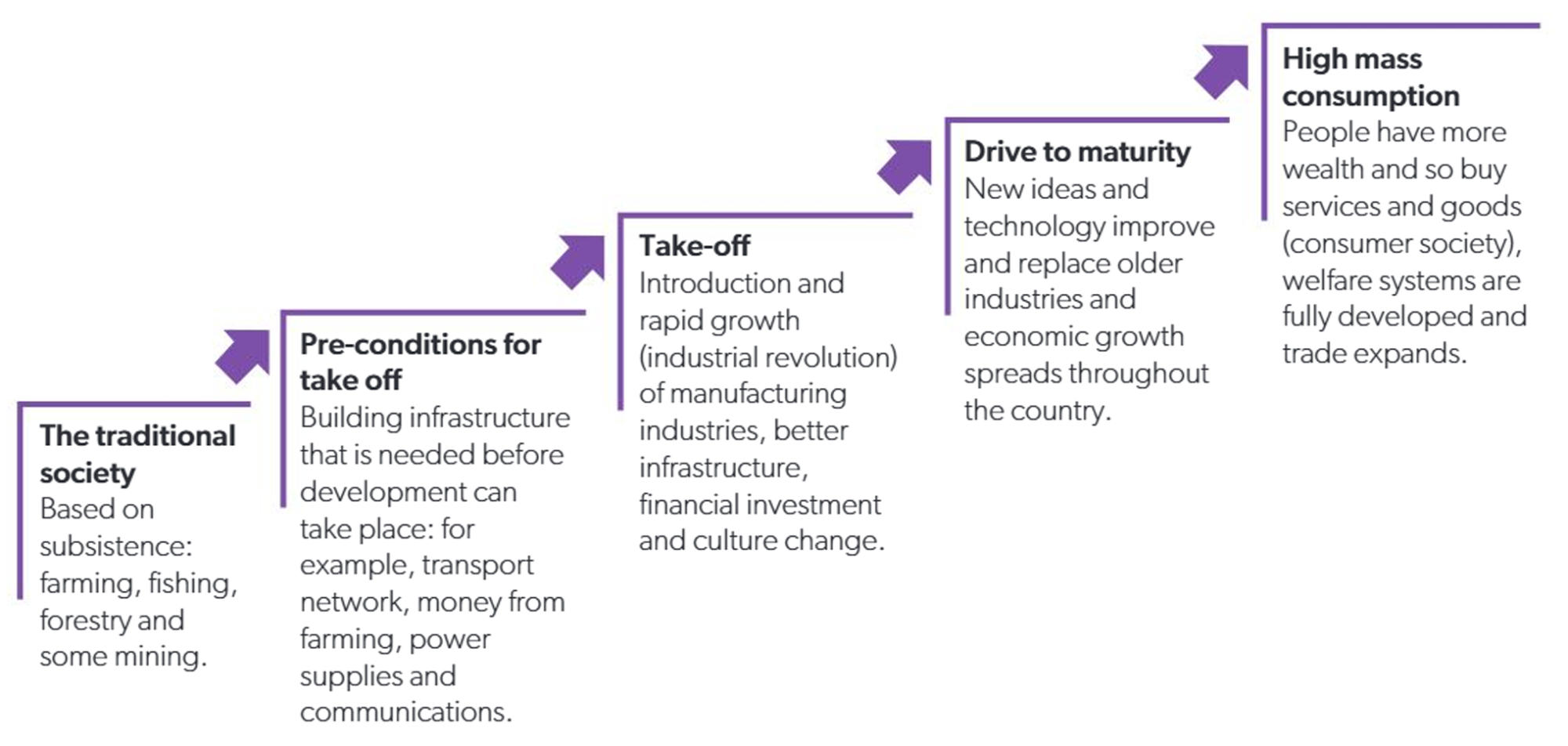
2nd stage is the emergence of positive conditions pre-development. Can be influenced externally by trade and comms
3rd is most important, reached when investment and industrial output rise. Support and restructuring social and political institutions
last 2 involves establishment and consolidation of development
Modernization Theory
Western-led idea of moving from traditional to modern, industrial societies
Obstacles to development such as corruption, distrust, political instability, civil war, gender discrimination impedes development.
Benefits are expected to filter down to less developed areas
Dependency Theory
underdevelopment is caused by external, exploitative, and historical inequalities. Where “Periphery” states are dependent on a “core” nation
Calls for underdeveloped nations to break unequal ties with developed states to grow and attain development
The Anthropocene is the “human epoch” where human activity has significantly disrupted Earth's systems (atmosphere, biodiversity, natural processes)
Human Development: the development of freedoms and capabilities of individuals and groups.
The main pillars of human development are:
- access to healthcare and education
- liberty to participate politically
- equal opportunities
- equality (in income and gender)
case study: Capability theory p. 134
Based on premise that economic development in terms of GDP (gross domestic product) doesn't guarantee a good quality of life. The theory says focus of policy should be to ensure a person's well-being and development, to provide the freedom to live the kind of life they choose or find valuable. Can be in health, education, political freedom, etc. Some may need economic resources or need a social structure. This structure should be used to inform development policy. Central human capabilities listed include:
- ability to live a life of normal length
- good health, nutrition and shelter
- ability to use senses, imagine, think, reason and have education to realize all of these
- ability to life for others and show concern for other human beings
- ability to laugh and enjoy recreation
Sustainable development requires global cooperation for two reasons.
Problems confronted by state and non-state actors have become global in
scale. This is partly due to increased interconnectedness and globalization,
but also due to the rise of transnational issues, such as air pollution.- Global challenges, such as the climate crisis, require massive transformations
in how economies and societies are run. Today, this increasingly popular
perspective has inspired calls for a "green economy" , "green solutions" ,
"responsible capitalism" , "circular economy" , "degrowth" and "inclusive
growth" as attempts to remodel economies in ways that are more attentive
to, and conducive to, sustainability.
One criticism is that it puts too much focus on human / anthropocentric view.
Shows that development policies can become a method of soft power
Interactions of political stakeholders and actors#
There is bilateral aid (involving 2 states) and multilateral aid (involving multiple states within an IGO)
Development aid come in the form of:
- capacity building programmes
- programs to promote gender equality
- infrastructure projects
- financial assistance in the form of loans or financial aid
- technical and scientific assistance
- humanitarian assistance
- educational exchange and healthcare programs
Case study USAID and the Belt and Road Initiative (BRI) p.140
The US allocates billions a year for USAID overseas assistance program. Has found criticism for promoting its agenda in developing countries (particularly with AGRA - promoting agricultural yields using chemically intensive processes, among other issues)
Similarly, China also has its own BRI project. Again criticized for extending influence. Such as being a debt trap, where states are indebted to China
extension: the US has had major and rapid restructuring of foreign aid, an executive order in Jan 2025 it has paused most foreign aid, and by March had cut by estimated 83%
3.2.2 IGOs#
The UN Development Program (UNDP) and the WHO, UNDP is an agency whose goal is to “end poverty, build democratic governance, rule of law, and inclusive institutions” - known for reports on human development
Case study Conference of the parties (COP) p. 142
commitments by several UN states, yet criticized for being a performance to save capitalist economy.
International financial institutions (IFIs) – the largest being the International Monetary Fund (IMF) – this usually gives but the state must agree under a set of conditions - loan conditionality - the most criticized aspects of IMF, since may reduce gov spending on social services like hospitals and schools
3.2.3 Multinational and transnational companies (MNCs and TNCs)#
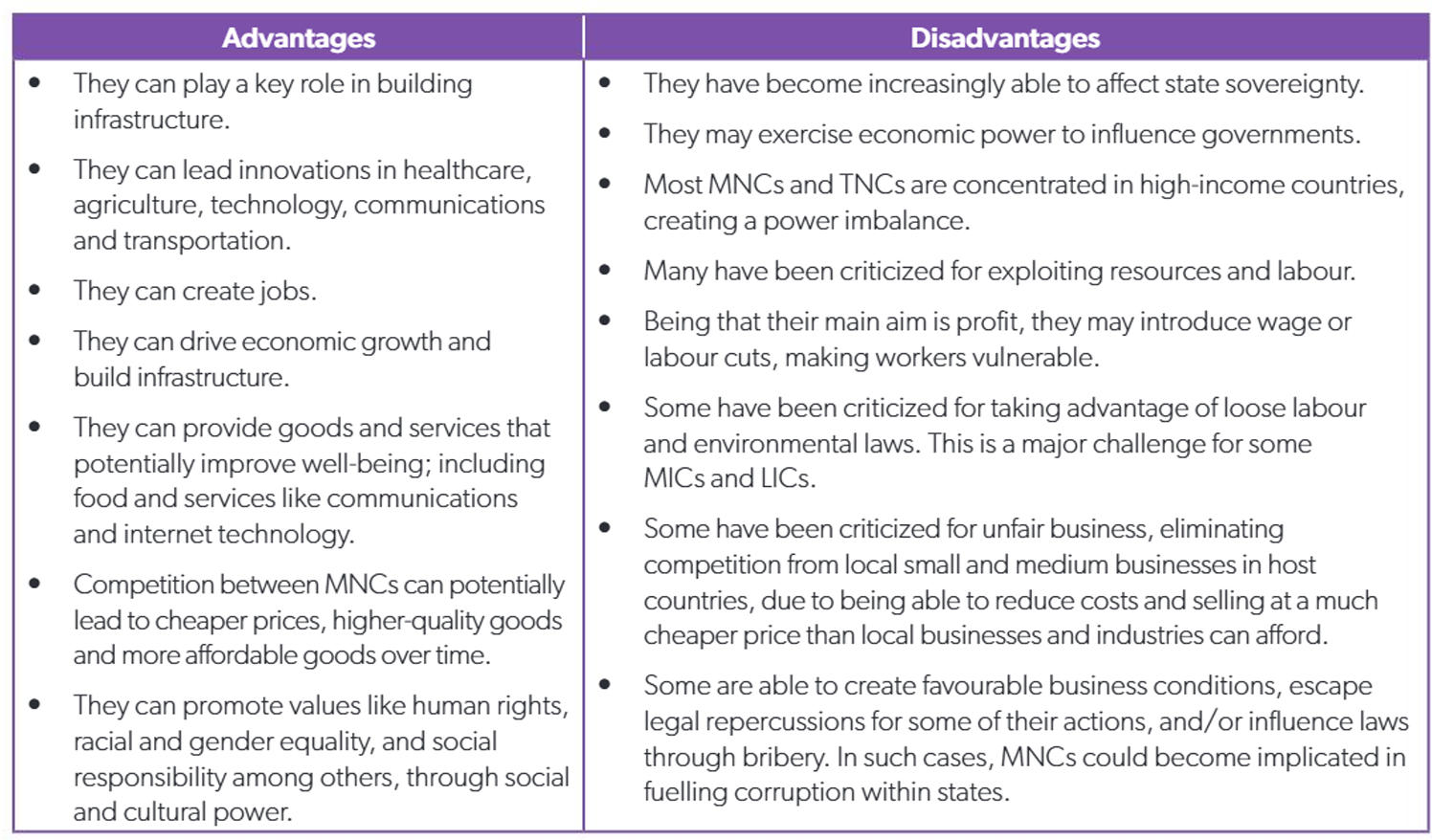
these play an important role in driving industry, technology, economic growth, job creation and service provision. They have the ability to influence states and affect populations
In 2019, The Guardian published a report revealing that 35% of all greenhouse gas emissions released between 1965 and 2019 were caused by 20 oil and gas companies that were either state-owned or privately run.
Case study Shell in Nigeria p.145
in 2011 an assessment by the UN Environment Program revealed land, ground, and surface water, vegetation and air were contaminated by shell operations. Requiring 25-30 years of cleaning and rehabilitation until fully recovered
Table:
3.2.4 Civil Society#
acts as a medium between citizens and gov
Case Study US Labor unions in 2022 p.147
in 2022, # of labor union strikes in the US increased by 50%. In September 2022 over 15k nurses in Minnesota did a strike, considered on the largest private sector strikes in US history.
Described as bottom up - community shapes development policy
3.2.5 Marginalized, vulnerable or most-affected groups and individuals#
includes those left out or ignored in development policies (intentionally or not). Said that economic, political, and social structures underpin this
Case study Israeli development of the Naqab-Negev p.149
the Naqab-Negev are indigenous people living in that region, a project promoted by the Jewish National Fund used greenwashing to hide impact the production has on local populations
3.3 Nature, Practice and study of development and sustainability#
3.3.1 Dimensions and assessment of development and sustainability#
GDP calculates the total goods and services produced within a country's borders - indicates size of economy and how much it has grown over a year, then divided by population size to measure share per person – GDP per capita.
US and China topped the list in 2021
criticized for being narrow, where higher doesn't mean improved standard of living. Doesn't consider inequality and income, and assumes people have equal share of wealth. Doesn't consider informal economy
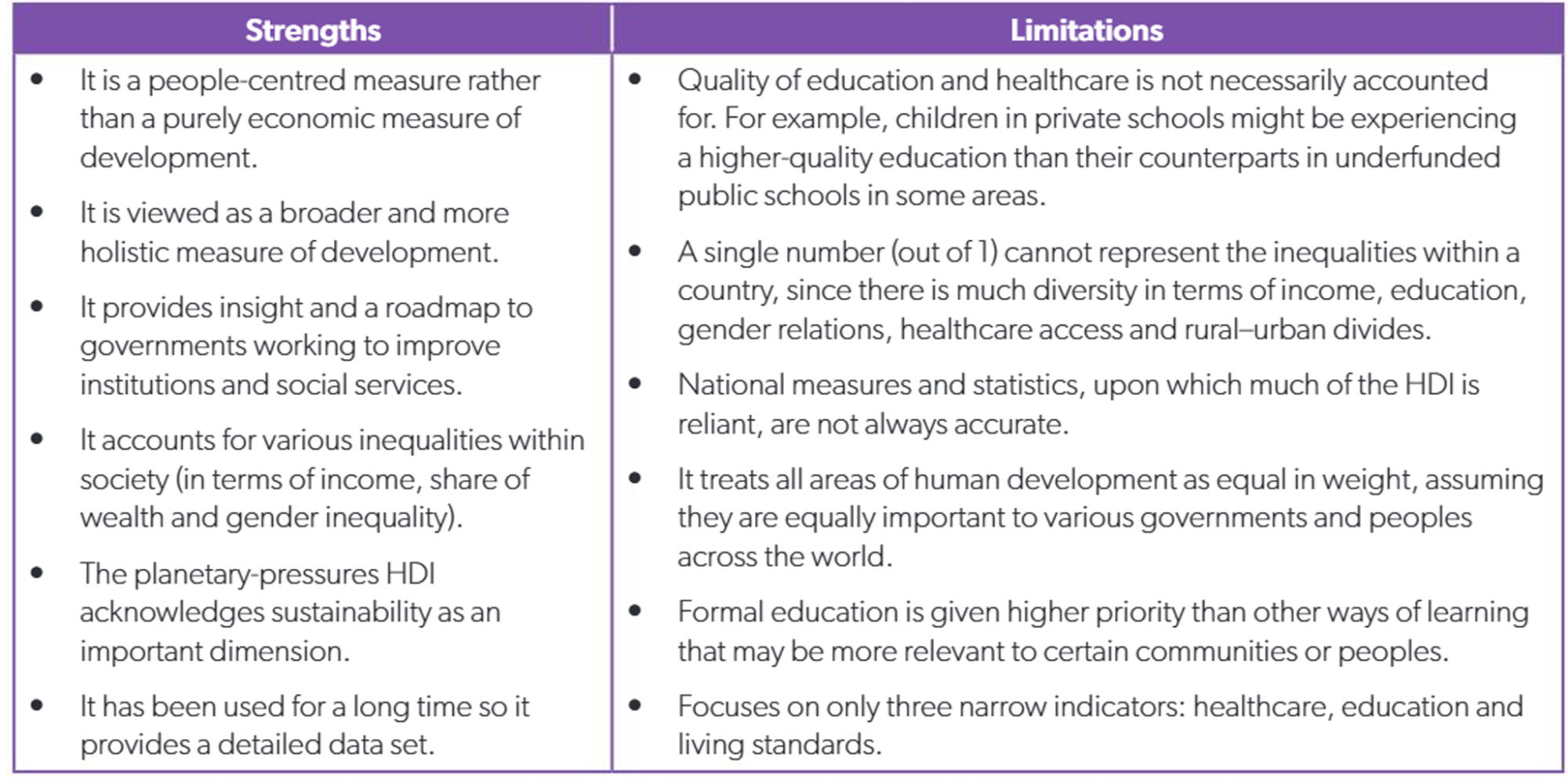
Human Development Index (HDI)
created by UNDP. A composite indicator, the 3 being:
- access to a long and healthy life
- access to knowledge in the form of education
- standard of living (measured by Gross National Income per capita)
The closer to one, the more developed it is seen as being. Switzerland and Norway had the highest score in 2021
other UNDP measures:
- Planetary pressures-adjusted Human Development Index (PHDI) accounts pressures in planet by emissions per capita
- Inequality-adjusted HDI (IHDI) accounts if distribution is unequal
- Gender Inequality Index and Gender Development Index compare inequality of men and women
Table of strengths and limitations:
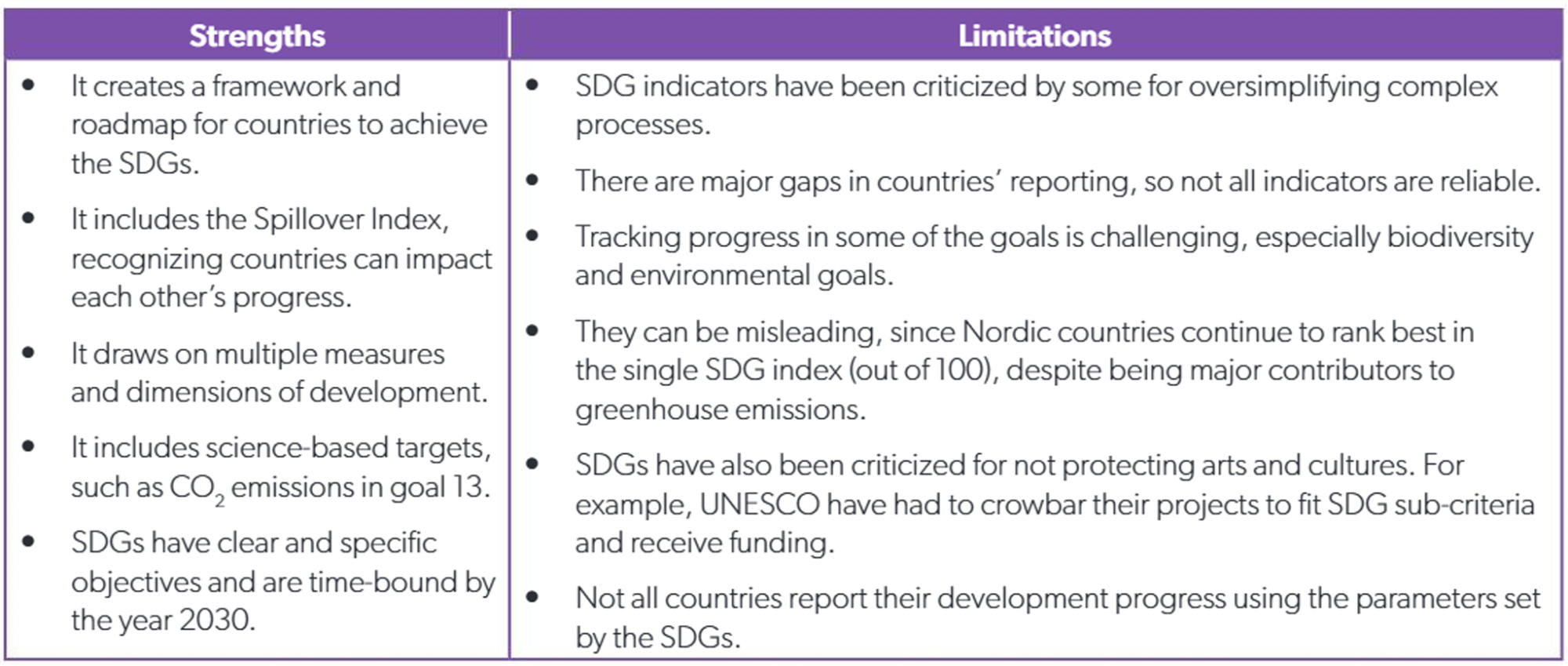
There is a new method of measuring ability of country to achieve the SDG goals (cool circle thing)
Table of measuring development with SDG indicator:
Happy Planet Index (HPI)
ability to provide long and happy and sustainable lives
Case study Gross National Happiness (GNH) index p.154
A holistic view of population's well being
3.3.2 Pathways towards development and sustainability#
if economy is important state will prioritize that, another maybe education
Neoliberalism: economic theory and model emphasizing free market and limited government intervention – economic growth driven by corporations
opposite end of spectrum is state-led development
Common policies associated with neoliberalism include:
- tax reforms: reduced taxes
- austerity measures: reduced public spending on social services
- trade liberalization: minimal barriers to free trade and foreign investment
- privatization: transfer of public enterprises to privately owned ones
- deregulation: limited government intervention in the market by the removal
of strict regulations.
Efforts to put these conditions are in the form of Structural Adjustment Programs (SAPs) by the IMF and stuff– these often fail to create sustainable economic growth, contribute to inequality and cycles of debt. These also limit a govt's ability to protect people, encroach on worker conditions and labor rights.
Case Study Jordan and the IMF p.156
In a mixed economy, a gov usually maintains control of some key industries – Known as the Nordic model – - existing in Norway, Denmark, Finland, Sweden, and Iceland in varying degrees - these states often perform best in human development metrics
By taking a state-led approach, the state can direct its resources towards national goals such as increasing trade, or promoting rural to urban migration to drive industry. State can control what is imported in the form of tariffs to protect industries
there is not necessarily an absence of free-market economy, where China and Singapore are active in it but on their own terms. A point of scrutiny for China since it exports freely but imports are difficult
Case study: US-China trade war p.158
reciprocal tariffs known as trade war. Trade wars have not reduced Chinese economic growth, nor did it address trade deficit in the US. Many argue it has harmed global trade and relations between US and China
Scientists argue the idea of growth is intrinsically non-ecologically friendly, no matter how green they paint the idea. Since growth is unlimited, but nature has its limits.
3.3.3 Factors affecting development#
Factors do not act in isolation – an interplay of factors
For instance, high debt results in reduced spending on education – affects both economic and human development
Table of possible factors affecting development
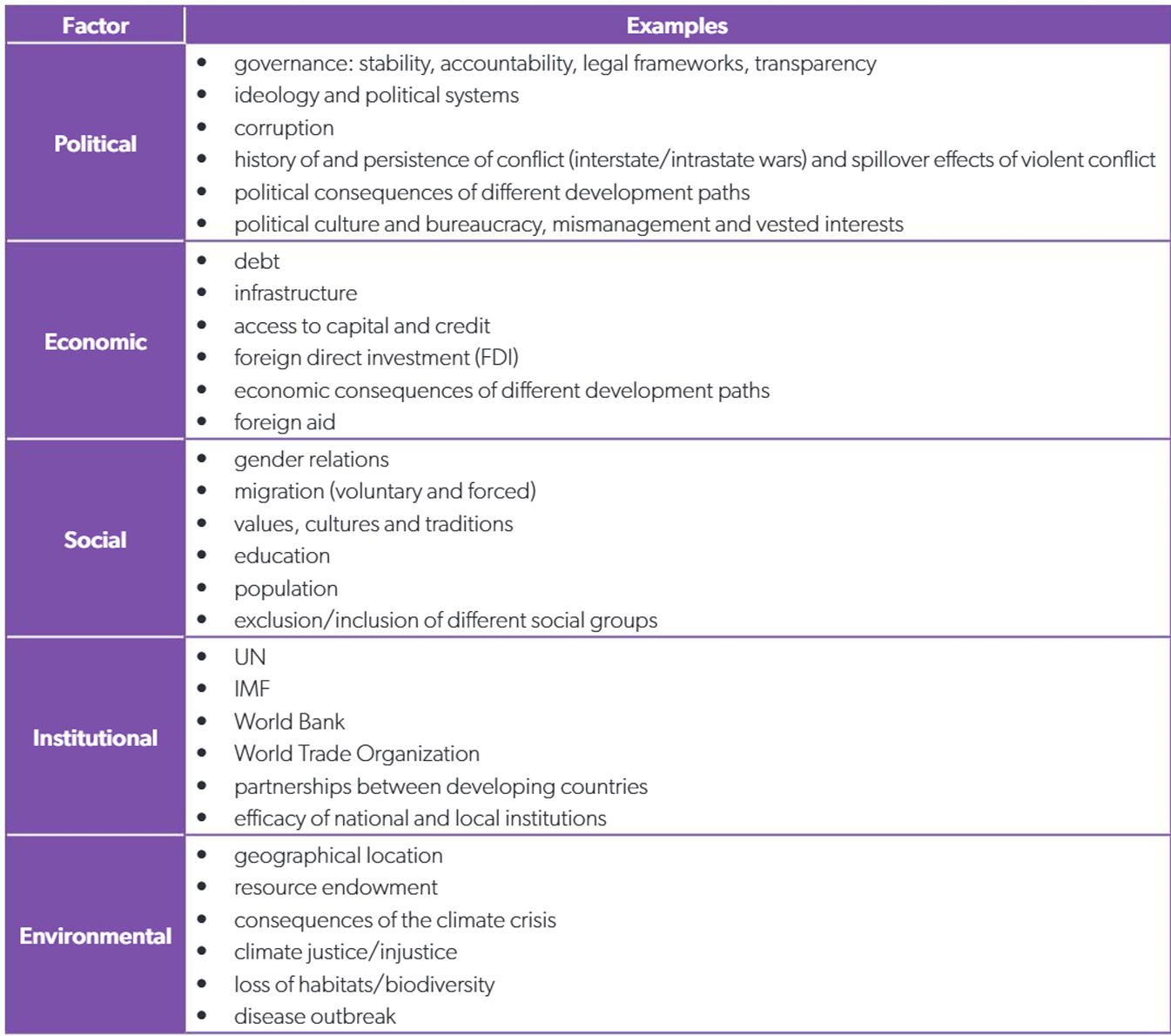
Factors affecting development can be politicized, meaning used for political and economic gain. Populist leaders (try to appeal to masses) blame gov failures of development on refugees or migrants. Aid is also politicized, and used to explain why it succeeds or fails. Overpopulation in MIC/LICs are often blamed for poverty when in reality economic and political structures are the main cause
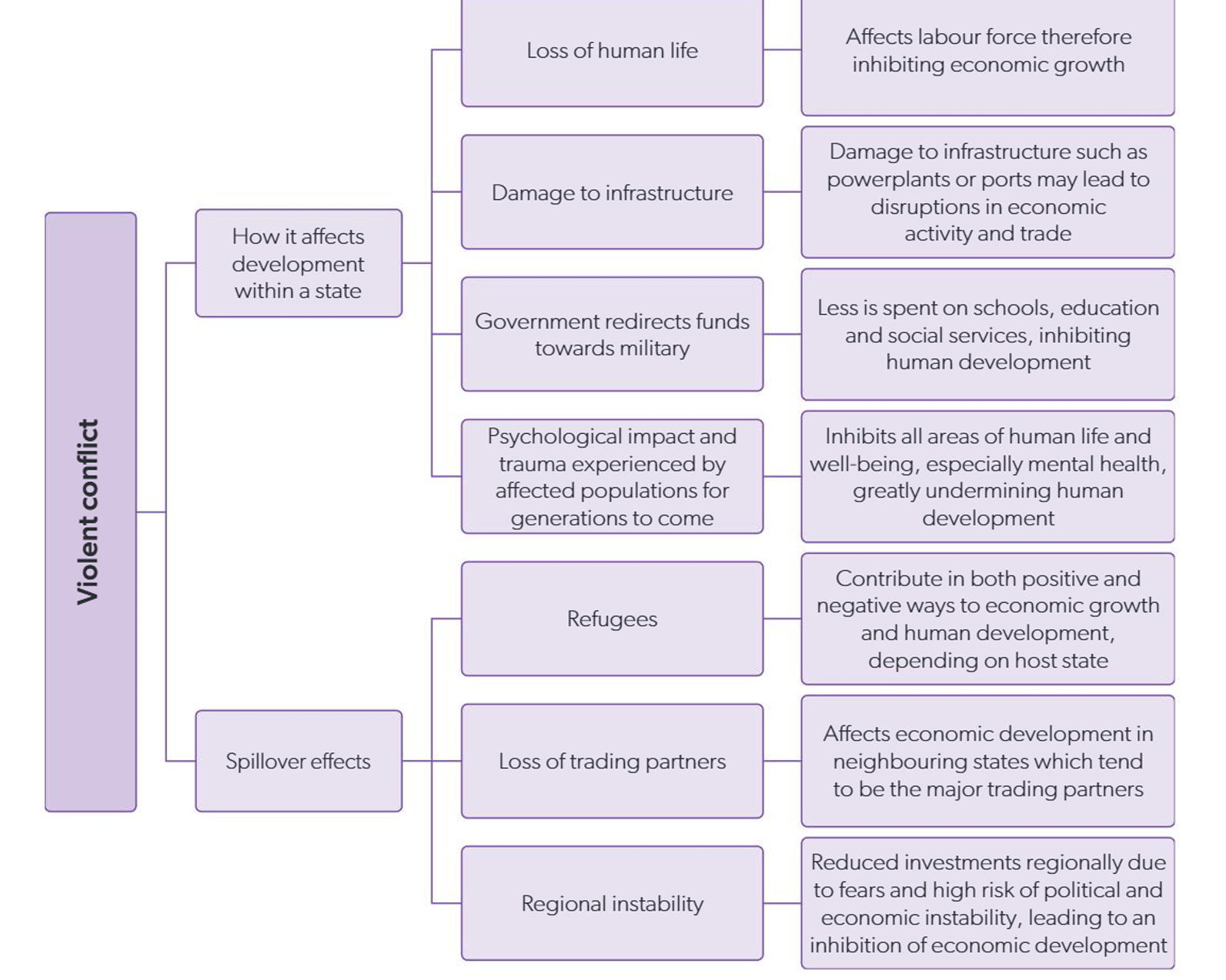
As development depends on stability, violent conflict tends to inhibit development significantly
Effects of violent conflict on development
Case study: Sanctions in Syria p. 162
Sanctions were imposed on Syria by the US, inhibiting the ability to produce life saving medicines and vaccines, crippling the economy.
Economic Factors
for recovering countries, aid is required to ensure relief and stability, aid can also promote reliance patterns. A corrupt government could also misuse aid for private aid.
Loans can be useful, but the resulting debt can be a disruptive force, as it accumulates there is less to be spent on social services or infrastructure.
Social Factors
Gender relations – check how women carry out at least 2 and a half more unpaid household and care work than men
It is not always the case that a large population leads to development. For example, if a boom in the population is not matched with opportunities to work, this would lead to high levels of unemployment and dissatisfaction and possibly social and political unrest.
Therefore, an increase in population can be positive only when
there are work and employment opportunities generated by investment and/or
government employment initiatives.
Migration can introduce skills and innovation – increased productivity, innovation, and economic growth. Can fix labor shortages in particular industries
Case Study: Middle Eastern refugees in Germany p.165
many Syrian refugees found asylum in Germany, where there was an aging population and low employment rate. Many refugees held degrees and were skilled under 40, they could get employment. Over found jobs in 2021, and many are pursuing education. Expected to help Germany in the long term
Institutional factors
Effective local institutions can identify community needs and respond effectively as they are familiar with the socioeconomic conditions of a city / town / locality. National governments may not be able to do that since they are broader.
They can be harmful as well, if these are corrupted, fragmented, or suffer from lack of experience or skills the process of development could be derailed
Environmental factors
When looking at global trade, it is important to understand much of it happens over sea. Major ports have become key drivers of economic growth. Land trade tends to be more expensive and difficult, a difficulty for landlocked regions.
Sustainable development aims to slow climate change and mitigate its impacts. the natural disasters affecting agriculture and such affect the poor the most - with disease, hunger, and malnutrition adding to healthcare cost. A report by the Intergovernmental Panel on Climate Change in 2007 highlighted the poor will bear the brunt of climate change.