 Global Politics
4.1.3
(not entire section, just from 275-284)
Realists argue that the world is mostly conflict ridden, with times of peace being the exception
Some liberals argue that through international institutions, a state of peace is possible
Peace is a multi-layered concept. It represents a condition of harmony, justice and cooperation at
every level, from personal to global, where members of a society can flourish at all levels.
- Community Level
- equal access to services and resources
- National Level
- gov ensures safety of citizens
- Global / International Level
- not only absense of war but cooperation
According to Johan Galtung, peace can be either negative or positive. While the term megative’ can be confusing, it simply means that the violence has been removed, or it is absent. It does not mean that positive changes have taken place in order to create a more thorough and long-lasting peace in society.
So, we can say that one of the main characteristics of peace is the absence of violence. If that is the case, then our understanding of what peace actually looks like must be based on how we define violence. Galtung states simply that ‘violence is needs deprivation’.
Components to direct violence:
- intentional and personal
- intended to hurt another individual
- can impact 1 or many, physically or psychologically
- can be instantly recognized as being hurtful
ex. injury and death from war. Ending the war would create ‘negative’ peace - called such since violence causing damage has been removed thereby the further possibility of injury/death
But doesn't mean improvements to societal structures have been made, such as the causes of the war in the first place. negative means that the peace described is only without personal violence.
Negative peace is simply the absence of direct or personal violence. This perspective doesn't consider the positive structures to make peace long-lasting
Structural Violence
Structures in society causing harm or are unjust
This differs to direct violence in that:
- difficult to identify an individual who is directly aiming to hurt another. Rather, structural violence is built in the structures of society/organization that can result in unequal power/opportunities. Therefore it relates to policy and how policies can limit freedoms / opportunities
- people might pay more attention to direct violence since it is more apparent. These might go unnotices
If structural violence is revealed (manifested), those in power may enact direct violence to maintain benefits, and those experiencing may use it to break barriers
Case study: Migrant labor as direct and structural violence (277)
In the Kafala system in some Middle East countries migrant workers are sponsored, yet the sponsors can revoke the legal protection at any time, giving them lots of power.
The Kafala system can be seen as a structure of violence then, putting structures in place causing inequality and discrimination. It also creates direct violence with employers enaging in physical abuse, sleep deprivation, etc. Changing regulations for fair wages and working conditions are called ‘positive peacebuilding’
Cultural Violence:
This is related to aspects of culture: religion, art, language, sport, and ideology. Can be used to justify / legitimize direct or structural violence.
One way cultural violence works is by changing the moral color of an act from red to green or at least yellow (acceptable)
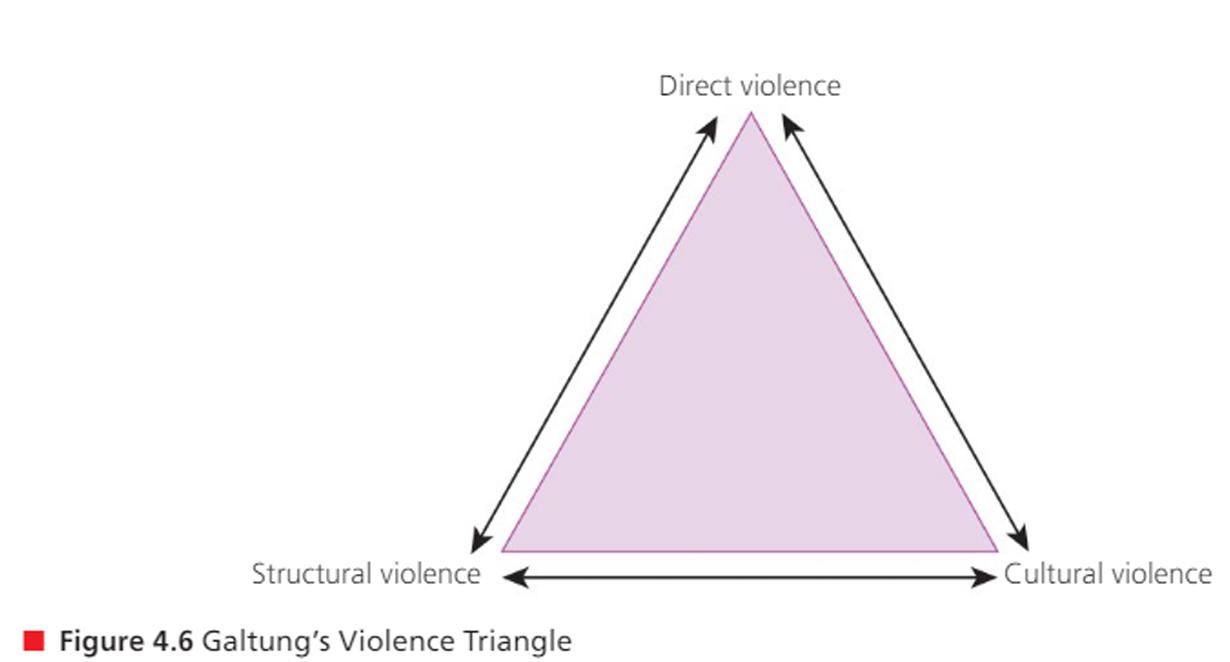
The points are arbitrary. if we were to place direct and structural violence at the bottom of the triangle,
we could say that it is cultural violence that legitimizes direct and structural violence. If we
turned the triangle so that direct violence is at the top, then structural and cultural violence
can be viewed as sources of direct violence. if structural was at the top, could say that structural violence reinforces the other forms of violence
Galtung says acts of violence usually move from cultural to structural to direct violence. Can also think as:
- Direct violence is an event
- Structural violence is a process / framework that institutionalizes violence
- Cultural violence is a way of thinking
Basic Human needs
Galtung says we should consider 2 aspects of needs: basic human needs, and ecological balance
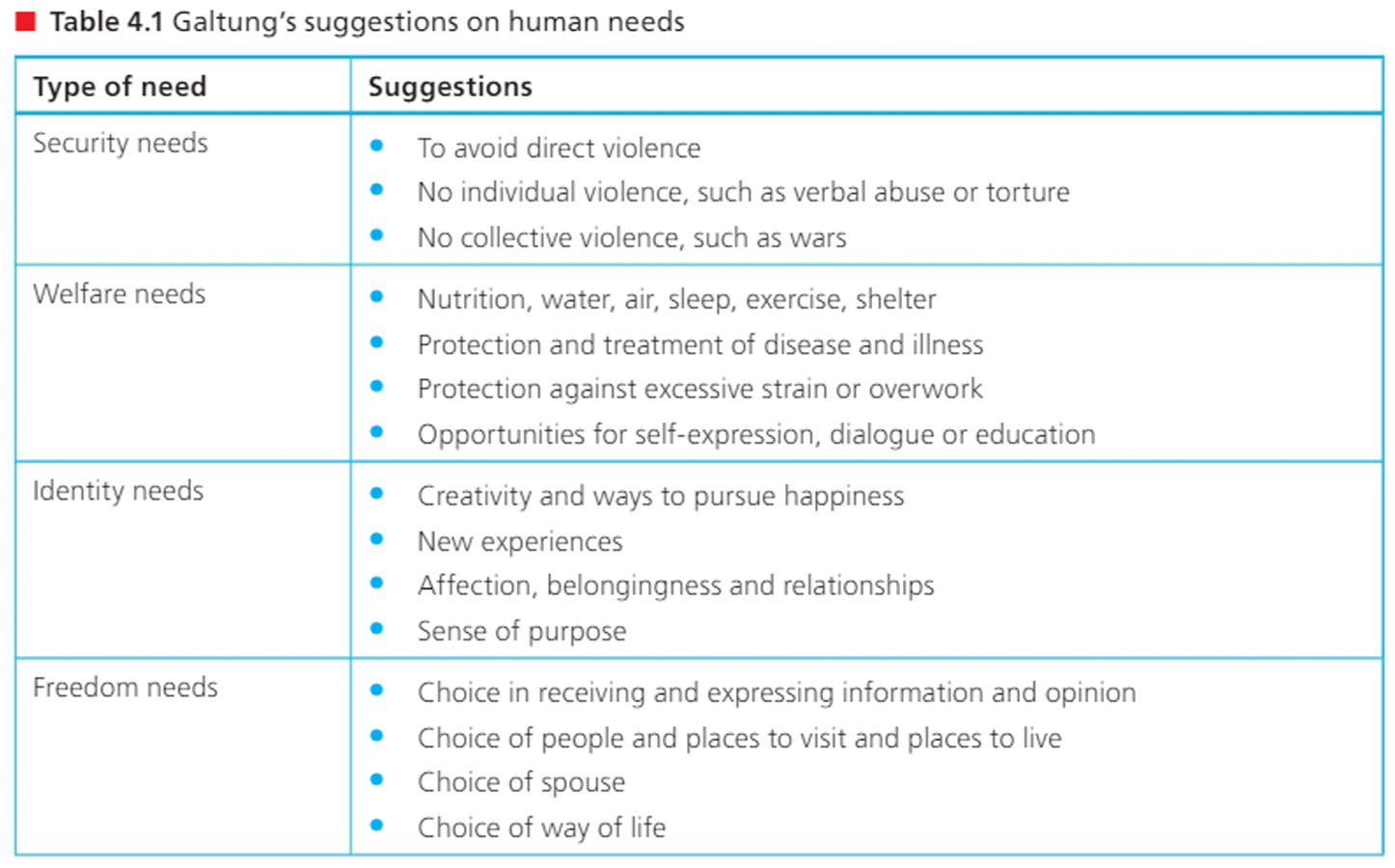
Brian Orend also lists five aspects of human needs
- Personal security
- Material subsistence (enough minimum like food, water)
- basic equality
- personal freedom
- recognition as a member of the human community
Consider: wanting someone to do something is not a need - not direct violence. Results of an earthquake for example may not have analysis, but lack of government measures to promote safety measures can be considered structural violence.
Galtung suggests then that violence is anything that gets in the way / increases the distance between your current or actual circumstance and a potentially better, more peaceful circumstance. An act of violence then is a barrier so you are unable to move to the better situation.
Positive Peace
Positive peace is the removal of structural and cultural violence. It includes concepts like legitimacy and justice.
"Ramsbotham et al. have challenged the idea of positive peace, calling it “deeply problematic’ They
explain that ‘injustice’ is often equated to ‘perceived injustice’, which broadens the idea of injustice
so that it also includes all of politics. They argue that nothing is more characteristic of perceived
injustice than violent conflicts where ‘all parties genuinely believe that they are victims of injustice
and that therefore “justice” is on their side’ Furthermore, some fight against perceived injustice
yet use force in order to do so."
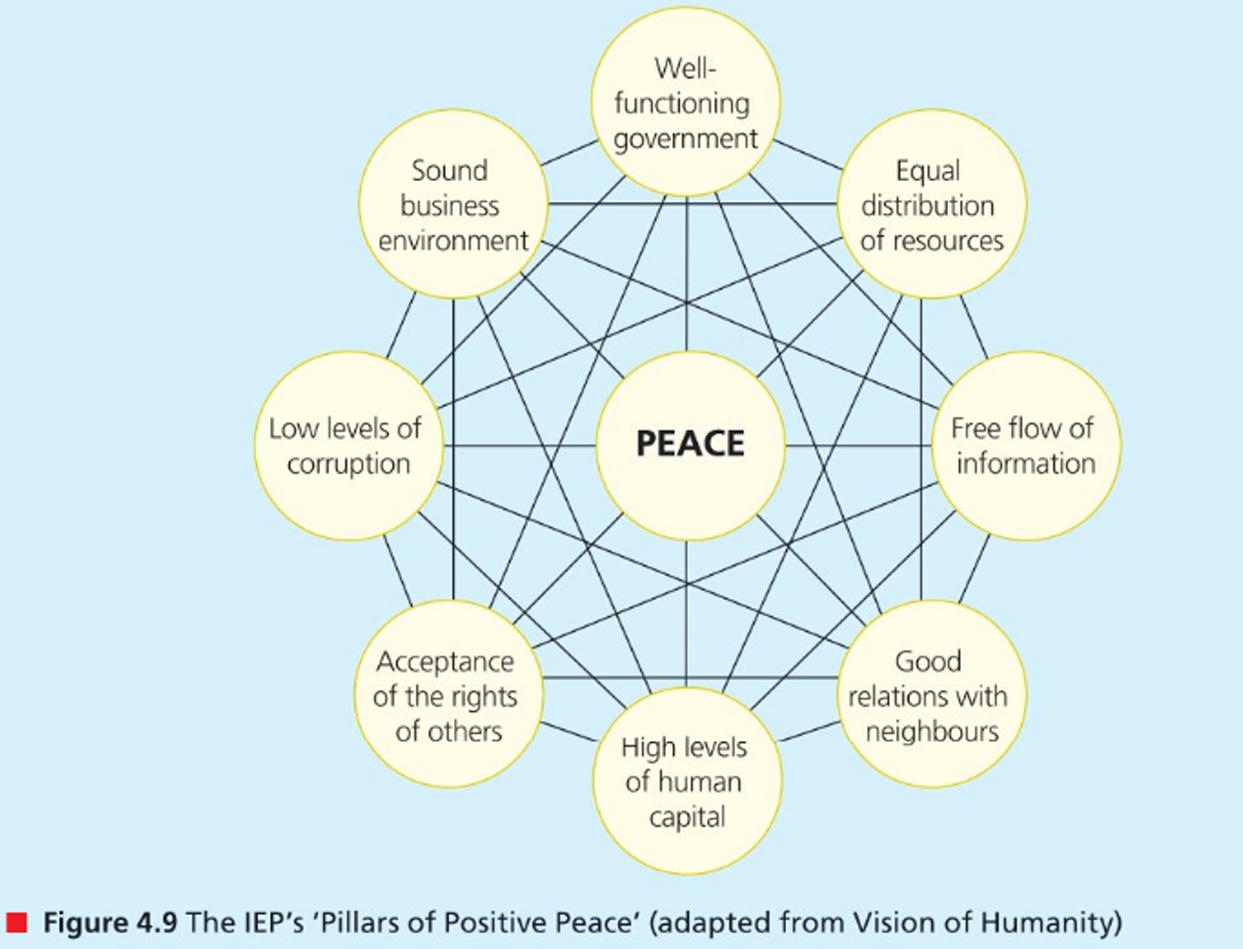
IEP is Institute for Economics and Peace
Dustin Sharp has said the term negative is problematic, since oftentimes it is quite desirable and there is lots of nuance in the situation.
Sharp argues that the idea of positive peace as social justice is too broad and vague to offer a meaningful vision of peace. He suggests that concepts like positive peace and structural violence could be viewed as loose metaphors instead of a model or descriptions of what peace is.
Third, Sharp suggests that the idea that positive peace is the breaking down of
structural violence is problematic because it limits the causes of inequalities to societal
structures and neglects to include inequalities which may result from things like ‘luck,
grit, intelligence, individual choices and agency, and many other factors'.