 Global Politics
Unit 3 - Development and Sustainability
Course companion:
While development has led to decreased poverty, improvements in lives of many globally and wealth, it has also led to growing inequalities both within and among states, human rights abuses, and global scale crises – led to sustainability being heavily tied to development with the 17 UN Sustainable Development Goals (SDG)
- sustainable development requires global effort and cooperation - especially with a globalized and interconnected world
- sustainable developments is an intersection of peace, equality, environmental protection, and respect for human rights
Main Book:
180 - 202
Contested Meanings of development#
The Society for International Development defined development as ‘a process that creates growth, progress, positive change or the addition of physical, economic, environmental, social and demographic components’
Development is a multidimensional concept which can be measured and defined in a multitude of ways
Historically measured with economic terms, like GDP - Gross Domestic Product, but there are more wys to explore:
- Human Development
- Social Development
- Environmental Development
- sustainable Development
Development could also be based in independence and self-reliance. Can result in tackling corruption, or industrial development.
(182) One difficulty in development is operationalizing the concept – meaning turning abstract conceptual ideas to a measurable observation (development indicators). This is due to the contested nature of the concept, thereby leading to no single unit of measurement in development. This is linked to the multidimensional nature.
4 dimensions of development:
- political development
- often considered towards moving to greater democracy (democratization) and government accountability, with added respect and protection of human rights
- Thomas Carothers argues 2 schools of thought:
- Developmentalists argue authoritarian rule is necessary for poor countries to develop. Democracy is a secondary concern and only care about when development is well underway
- Pro-democracy voices any country can become democratic so long as citizens are in favor, no matter social/economic development
- Bypassing states to channel development by NGOs for instance can be seen as compensating for weak institutions in recipient states if we see government as a problem rather than a solution
- Governments have the responsibility to explain and justify – key since corruption and other practices can thrive
- and people can just vote out the unwanted ones
- Human right respect and protection:
- Article 1 of UN Declaration on the Right to Development that without embarking towards development, all other human rights cannot be realized effectively
- “The right to development is an inalienable human right by virtue of which every human person and all peoples are entitled to participate in, contribute to, and enjoy economic, social, cultural and political development, in which all human rights and fundamental freedoms can be fully realized”
Article 1 of UN Declaration on the Right to Development
- social and human development
- According to Browne and Millington can include:
- reduced vulnerability
- inclusion
- well-being
- accountability
- people-centered approaches
- freedom from violence
- According to Browne and Millington can include:
- institutional development
What is an institution? (It doesn't really say – While organizations are concrete, institutions are broader frameworks)
Bretton Woods institutions – the World Bank and the International Monetary Fund - made in 1944 to aid global economic recovery
- economic development
- can be economic growth in the form of productivity & revenue
- can also be seen as establishment of new industries, and economic diversification
- adding things like resources to reduce risks that come with relying on a single source
- Impacted by:
- access to resources
- infrastructure
- debt
- capital and credit access
- trade, aid, investment
- informal economy – if formally recorded, would add value in GDP and tax revenue.
Sustainability#
2 main debates
- the extent the 3 components (economic, environmental, social) are equally important
- whether environmental sustainability is actually more fundamental and is the basis that the other 2 can be developed.
Distinguish sustainability and sustainable development:
Sustainability is the long term goal, sustainable development is the process and pathways (in short term) to achieve the goal
Environmental sustainability:
basically just the effects of climate change, and who is imapcted and can make change (local or state)
Social sustainability:
- clean water, nutrition, security, well being, justice, democratic systems of governance, democratic civil society
Can look at Maslow's hierarchy of needs
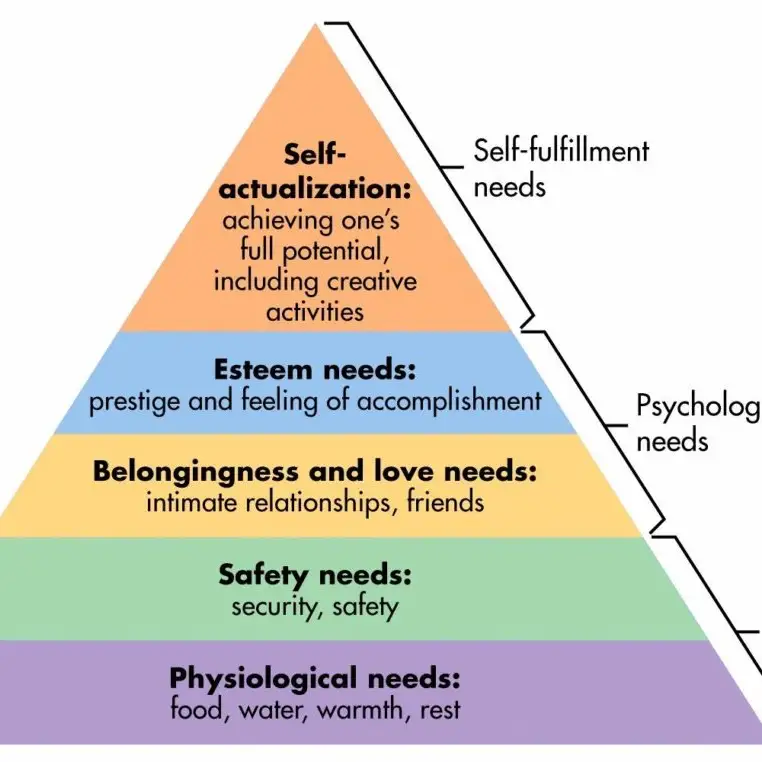
Look at women: Educated girls are less likely to face discrimination, safer and protected from exploitation and abuse
Economic sustainability:
there are models of ‘circular economy’, aiming to reduce, reuse, and recycle and remake products as much as possible
Also impacts new technology and innovations
Poverty & Environmental sustainability (191):
can be seen as a result of lack of environmental sustainability – see table 3.1 for relation
Poverty:#
Absolute and relative poverty
Absolute: when household income below a certain level to access basic needs
Relative: When households receive 50% less than the average household income, having some money but only enough for basic needs
Poverty as a lack of opportunity → more than just a lack of income and resources for sustainable livelihood, also includes hunger, malnutrition, lack of access to education and other basic services, discrimination & exclusion from decision making
Poverty trap:
The idea that the mechanisms that cause poverty are self-reinforcing, causing those in poverty to be the ones least able to escape from it.
Ex: higher levels of education can cost money, a resource less likely to be accessible to those in poverty.
Economic inequality#
income vs pay vs wealth
- income is from employment (wages / salary) and all money from investments
- pay is money earned from employment – can be in wages
- wealth is the total amount of assets of an individual or household - can include financial assets like property and land
Some may suggest that those with extreme wealth deserve it for working hard (Steve Jobs for example), data suggests that in the economy, inequality inhibits rather than drives growth. OECD analysis finds where income inequality is decreasing grow faster than those with rising inequality
Political inequality#
The unequal influence over decisions made by political bodies and the unequal outcomes of those decisions – heavily linked to power
We can consider conversation between governments and citizens, broken into voice and response:
- voice is the way individuals / groups express needs / wants from their government. Can be loud or soft
- Response is the way in which the government reacts to the expressed voice
We can reduce political inequality with higher voter turnout
86% of Americans earning around $150k voted in 2016 election, while only 48% in the lowest bracket did → likely not only income, but educational background
Certain groups can become disengaged and sometimes disenfranchised (those denied the right to vote – in US, those who committed a felony)
There is the potential for unequal outcomes
Check p. 199 for examples
39% of US federal prisoners are black, while only 14% of the population are black Americans
Social inequality#
members of society having unequal access to society's opportunities, benefits, and resources. This is not a standalone dimension but includes and is included in elements of political and economic inequality
Education, Healthcare
Check 200 for specific examples
Factors of reduced education like needing to work and ability to pay
Power Asymmetries#
Relationship between 2 actors where 1 has control over the outcomes of the other (the subordinate) but not vice versa.
This can be seen as the root of much inequality – these inherently pertain to who has power Phillips argues using economic, social, and political terms)
Page 202 has a case study of MNC in Africa axing institutions
p.202 Review Questions
- What challenges are posed by the fact that contested concepts are, by their very nature, difficult to define?
- – The ability to actually provide insightful metrics to quantify and learn where to improve on the concepts
- Without having a clear agreed upon definition, it becomes a challenge to actually decide which metrics truly matter to quantify and learn more about the concepts we desire to improve, as the things which are important to one person's definition in the issue can be completely different to another's.
- To what extent is it possible to understand one of the four concepts of development, sustainability, poverty, and inequality without reference to the other concepts?
- It would be highly ineffective to actually understand simply one of these concepts without the understanding of its interdependence and relation with the others, where their ideas are deeply interconnected. For instance, ideas of improving development hinge on first reducing poverty as poverty is an indicator of a loss of human rights, and improving development is based on the idea of increased access to human rights for all.
- What role does power play in our understanding of the concepts discussed in this chapter?
- Development:
- Western standards create the basis for legitimacy in the developmental status of states. These power hegemons can decide who benefits from certain systems.
- Sustainability:
- Sustainability in developed regions to undeveloped ones will look different in the goals that they have, with the ability to have access to basic needs being a necessity to promote sustainable development. For instance, farmers who are in poverty are more likely to practice more short term gains over ones that have the economic mobility to take a chance on environmentally sustainable practices.
- Poverty:
- The poverty trap is the idea that the systems that can promote an individual's growth in a society is highly inaccessible to those who are in the trap, thereby being caught in a self-reinforcing mechanism. These systems can manifest in the inability to vote or take part in other social processes, impacting the dynamics of power within a society.
- Inequality
- Political inequalities come to mind with the ability to actually be able to make changes to political decisions and the type of outcome that come with those decisions. Power can be taken in the unequal influence where some bodies have access to resources that allow them the ability to make political changes to their environment, and some members may be disenfranchised from the mechanisms of power in a society, such as with Americans who have been incarcerated losing the ability to vote.
- Social inequality can create disparity through the power seen in social structures, such as ethnicity or gender, marginalizing the ability of some over others.
- Economic inequality can skew society in many ways, where wealth inequality can lead to decisions taken in the interests of benefiting wealthy elites.
- Development:
p.203: analyze figure 3.10
Each actor and stakeholder is intimately connected when discussing development and sustainability. They should therefore not be thought of as being independent, and discussions on one should consider how the other categories view and respond to those ideas.